





High-Density Data Center Cabling: Meeting AI’s Insatiable Demand
AI DATA CENTER HIGH-DENSITY CABLING
Every AI model that answers a prompt, recognizes an image, or drives a recommendation runs on a physical foundation: dense server racks connected by equally dense cabling. As GPUs multiply and network speeds climb from 400G to 800G and beyond, the structured cabling inside a data center stops being a background utility and becomes a first-order design constraint. This article explains what high-density cabling really means for AI-scale data centers, how to design cable pathways that survive 100 kW racks and rising port counts, and how to choose cabling that stays reliable through the full life of the facility.
Why AI Breaks the Old Cabling Assumptions
Traditional enterprise data centers were built around predictable growth: a handful of switches, a few dozen racks, and cable runs that were easy to trace and easy to change. AI data centers break every one of those assumptions. Training clusters are built as a single enormous computing fabric, where thousands of GPUs exchange data constantly, and the network between them is as important as the compute itself.
The result is a density problem. Modern AI racks can draw 100 kW or more of power and carry hundreds of high-speed links. Every one of those links needs a cable, every cable needs a pathway, and every pathway competes for the same limited space above, below, and behind the racks. Cabling that worked at 10 kW racks or 25G ports quickly becomes an unmanageable tangle at AI scale.

Designing Cable Pathways That Scale With Compute
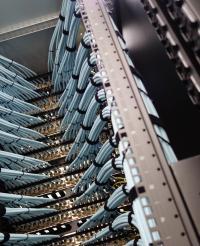
High-density cabling is not just about thinner cables, although that helps. It is about designing the physical infrastructure so that dense connectivity remains organized, serviceable, and air-friendly as the facility grows. Four decisions matter most:
- Overhead vs. underfloor routing — Above-rack overhead trays keep the cold aisle clear and make cable moves predictable; underfloor routes should be reserved for power and the few runs that genuinely need them.
- Separating power from signal — High-current power feeds generate electromagnetic noise. Keeping power cables and high-speed data cables in separate pathways, and crossing them at right angles, protects signal integrity at high rates.
- Planned slack and labeling — Dense bundles become unserviceable without disciplined slack loops and clear end-to-end labeling. Every cable must be traceable before the bundle is closed.
- Modular zones for change — Pre-terminated, modular cabling lets operators add capacity without ripping out existing runs, which is essential in a facility that is always growing.
Choosing Cabling for 400G, 800G, and Beyond
At AI scale, the choice of cabling media shapes everything from power draw to cooling load. Three families dominate modern data centers, and each fits a different zone of the network:
- Direct Attach Copper (DAC) — Copper twin-axial cables connect adjacent switches and servers with the lowest latency and no optical transceiver power draw. They are ideal for short in-rack and adjacent-rack links, and newer generations push reliable copper reach further at 112G and 224G per lane.
- Active Optical Cables (AOC) and optical transceivers — When reach exceeds copper’s practical range, or when density demands lighter, thinner links, optical cables carry higher bandwidth over longer distances with less bulk.
- Structured fiber backbones — The data center spine and cross-connect layers rely on high-fiber-count trunk cables and MPO connectors that consolidate dozens of links into a single manageable bundle.
The rule of thumb is simple: use copper where reach is short, use optics where reach or density demands it, and architect the backbone so the mix can shift as speeds climb.

Keeping High Density Reliable Under Load
Density does not only stress space; it stresses thermal and mechanical reliability. Bundles of high-speed copper cables trap heat, and dense cable trays can block airflow that servers depend on. Reliability at scale comes from attention to detail: using bend-optimized cables in tight paths, choosing flame-retardant and low-smoke materials for safety, respecting bend radius at every point, and leaving thermal headroom in cable-dense zones.
Equally important is planning for maintenance. In a dense environment, a single unlabeled or tangled run can take hours to isolate. Cable management hardware, proper slack, and disciplined documentation turn an unmanageable bundle into a facility asset that supports growth instead of blocking it.
Frequently Asked Questions
Why is high-density cabling critical for AI data centers?
AI training clusters connect thousands of GPUs into a single high-bandwidth fabric. Every GPU needs high-speed links, and every link needs a cable. At this scale, cabling becomes a structural constraint on density, cooling, and serviceability, not a minor detail.
Should I use copper or fiber in an AI data center?
Use copper (DAC) for short, high-density links where latency and power matter most, and use optical cabling when reach or link density exceeds copper’s practical limits. Most AI-scale facilities use a hybrid: copper inside and across adjacent racks, optics across the wider network.
How does high-density cabling affect cooling and power?
Dense cable bundles trap heat and can obstruct airflow, while high-speed active links consume power. Designing separate power and signal pathways, respecting bend radius, and leaving thermal headroom in cable zones keep density compatible with stable temperatures and efficient power delivery.
Conclusion
AI data centers are built on density: dense compute, dense power, and dense connectivity. High-density cabling is the physical backbone that holds those systems together, and getting it right determines whether a facility can scale smoothly or drown in its own cables. By designing scalable pathways, choosing the right mix of copper and optics, and engineering for thermal and mechanical reliability, operators can build cable infrastructure that keeps pace with AI’s demand today and stays ready for the next generation of speed tomorrow.