




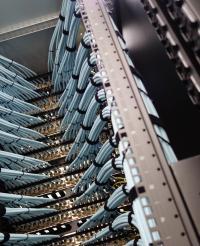
High-Speed Copper Cables in AI Data Centers: DAC, ACC, AEC, and the Road to 800G / 1.6T
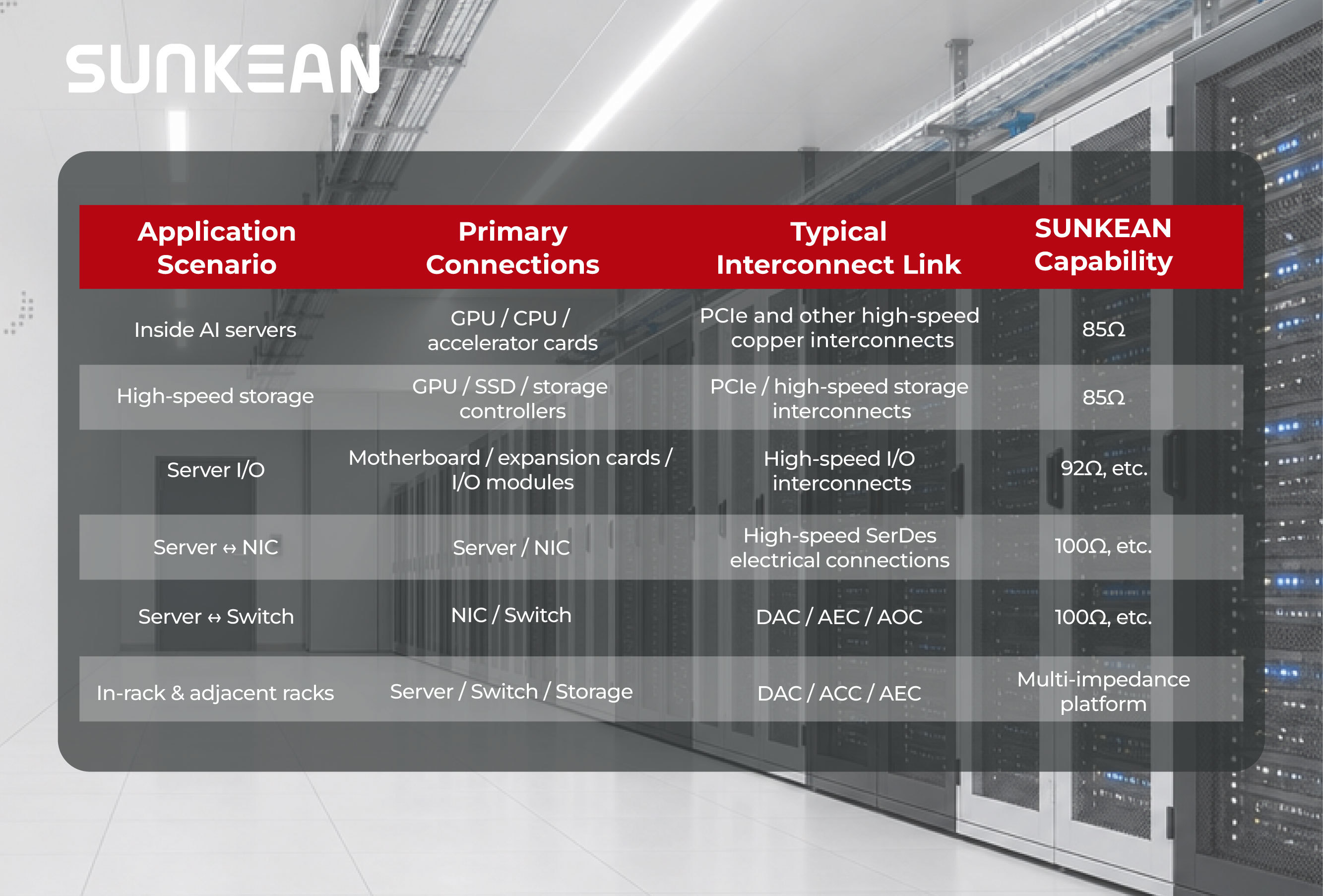
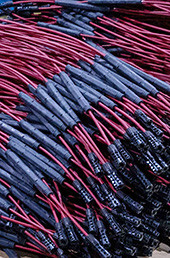
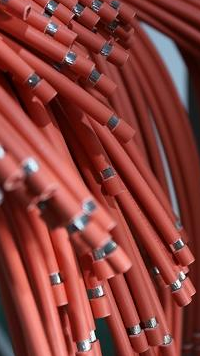
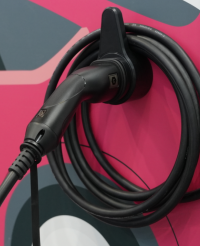
HIGH-SPEED COPPER CABLE · AI DATA CENTER · DAC / ACC / AEC / AOC In large-model training, GPU performance depends not only on compute capability, but also on whether data can be delivered to the GPUs continuously and efficiently. As AI clusters scale from tens of GPUs to thousands or even tens of thousands, the volume of data traffic between GPUs grows dramatically. Communication bandwidth, transmission latency, and interconnect efficiency are now critical factors in overall cluster performance. At the same time, data center networks are accelerating toward higher bandwidth: 400G continues to gain widespread adoption, 800G is entering large-scale deployment, and 1.6T is beginning to enter the planning and verification of next-generation AI networks. With every step-up in data rate, the physical interconnect faces higher requirements for signal integrity, transmission loss, power consumption, and connection density. The assumption that "the higher the speed, the more we should move entirely to fiber optics" is a common misconception. In fact, for short-distance, high-speed connections inside servers, inside racks, and between equipment, copper cables still offer irreplaceable advantages: no need for optical-electrical conversion, a simpler link structure, and—simultaneously—lower power consumption, lower latency, and lower cost. For short-reach interconnects of 1–10 meters, copper cables can often meet high-speed transmission requirements with higher system efficiency. This trend has already been validated by real-world AI infrastructure deployments: inside NVIDIA GB200 NVL72 racks, large numbers of high-speed copper cables connect compute nodes to NVLink switches, with approximately 5,000 copper cables per rack, totaling about 3.2 kilometers in length; in Meta's Llama 3 training cluster, which uses 24,576 GPUs in the training system, GPU-to-GPU interconnect relies heavily on copper interconnect, demonstrating the practical application of copper interconnect in hyperscale AI systems. More importantly, copper cables have not stayed frozen in the era of traditional, low-speed connectivity. From Direct-Attach Copper (DAC) to Active Electrical Cables (AEC), from traditional FEP insulation to low-loss materials such as foamed FEP and ePTFE, copper interconnect continues to push the limits of transmission speed and distance. For AI data centers, the real question is no longer "will copper cables be replaced by fiber optics," but rather: as data rates move toward 800G, 1.6T, and even higher, how far can copper cables still go? And what high-speed cable technologies will be required to support the next generation of AI infrastructure? Copper cable is not a single solution. As data rates continue to rise, different technology routes—from passive copper cables to active copper cables, and further to active optical cables—correspond to different requirements in distance, power consumption, and cost. Put simply: distance determines the technology route, power consumption affects system efficiency, and cost determines whether large-scale deployment is viable. This also means that high-speed interconnect is not a binary "copper or optical" choice; rather, it is an engineering trade-off between different technology routes. Over extremely short distances, passive DAC still offers clear advantages: a simple structure, low power consumption, and low cost. When distance increases and signal loss becomes the limiting factor, ACC and AEC can further extend the usable reach of copper by introducing active signal-conditioning capability. When distance continues to increase, optical interconnect—with its superior long-distance transmission capability—becomes the more appropriate solution. Therefore, the so-called "copper cable death zone" is, in essence, not a sudden failure of copper cables. Rather, as distance and data rate increase, the signal-integrity and power-consumption advantages of passive copper begin to shift, opening up greater application space for active copper interconnect solutions such as AEC. Behind this, an easily overlooked fact is that regardless of whether DAC, ACC, or AEC is ultimately adopted, the performance foundation of high-speed copper interconnect comes, first and foremost, from the cable itself. For AI data centers, there are large numbers of high-speed electrical connections inside servers, within GPU systems, between storage systems, and between network devices. As high-speed interfaces such as PCIe, 112G, and 224G continue to evolve, traditional copper cables can no longer simply meet the basic requirement of being "conductive." Impedance control, insertion loss, return loss, crosstalk, skew, and signal integrity are jointly determining how fast and how far high-speed copper cables can go. SUNKEAN starts from the most fundamental layer—the wire itself—and has built three major impedance platforms around different high-speed interconnect ecosystems, providing high-speed cable solutions for different protocols and applications: These different impedance platforms are not a simple "specification classification"; they correspond to the transmission performance and link-design requirements of different high-speed signal systems. At the same time, the performance of high-speed cables does not depend solely on impedance—the conductor, insulation material, foamed structure, shielding method, wire diameter, and manufacturing precision together determine how far high-speed signals can ultimately be transmitted and how stably they can operate. SUNKEAN currently covers different wire gauges from 26 to 32 AWG, and has established insulation and low-loss material systems including FEP, PE, foamed FEP, and ePTFE, enabling cables to be matched to different transmission distances, cabling densities, and performance requirements. For high-density AI servers, smaller wire diameters help increase cabling density and improve space utilization inside the chassis; for longer-distance high-speed electrical connections, conductor, insulation material, and structural design are required to reduce transmission loss, providing the signal-integrity foundation for higher bandwidth. Therefore, the real competition in high-speed copper cables is not simply "can it transmit 224G," but whether it can simultaneously achieve low loss, consistent performance, and scalable mass production in environments with higher data rates, smaller wire diameters, and more complex cabling. On the manufacturing side, SUNKEAN implements process control on critical parameters of high-speed cables through high-speed foamed extrusion, in-line dimensional monitoring, and high-frequency electrical performance testing. What these capabilities ultimately point to is not the mere pursuit of higher cable specifications, but enabling high-speed copper cables to reliably adapt to the connection requirements at different layers and over different distances across AI data centers. There is no such thing as a "universal cable" in AI data centers. From connections inside servers to inter-rack connections, different positions correspond to different protocols, distances, and performance requirements, and high-speed copper cables therefore take on different application forms. From these scenarios, it can be seen that what AI data centers need is not a single "copper solution" or "fiber solution," but a high-speed interconnect system that comprehensively matches protocols, data rates, distances, power consumption, and cabling space, and that combines different solutions appropriately across different connection scenarios. At the foundation of this system, the wire itself remains a critical basis for determining signal-transmission performance. As AI clusters continue to evolve toward higher bandwidth and higher density, high-speed copper cables will also continue to develop toward lower loss, smaller size, higher frequency, and more stable mass production. From inside the GPU, to servers, and on to switching networks, high-speed copper cables are becoming a connectivity foundation that cannot be ignored in AI infrastructure. SUNKEAN high-speed copper cables: engineered from the wire itself—where impedance control, low-loss materials, and process precision define the link. Contact our team for product specifications, samples, or project support.
Short-Reach Interconnect: Why Copper Cables Remain the Preferred Solution
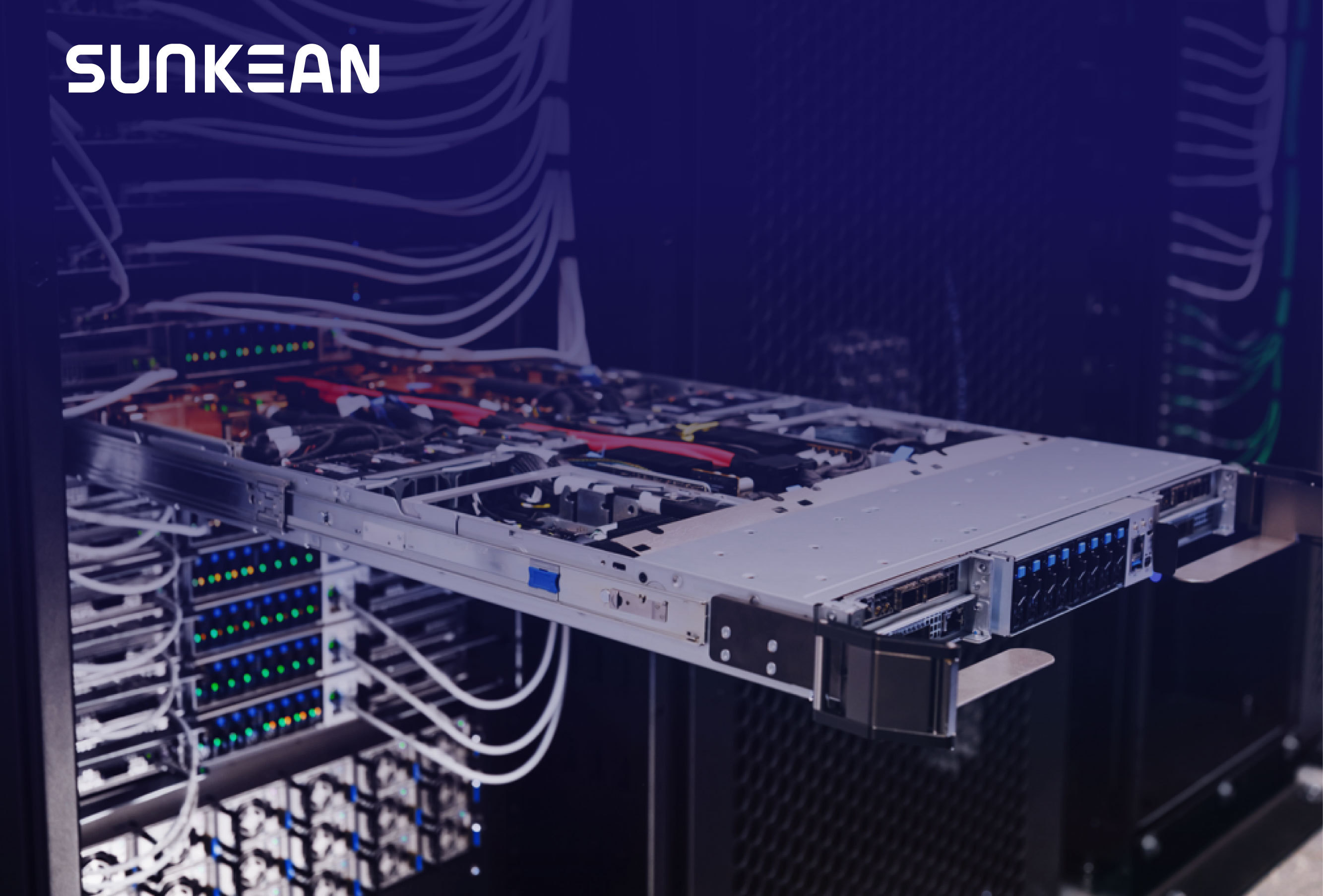
DAC, ACC, AEC, AOC: How to Choose the Right Short-Reach Interconnect
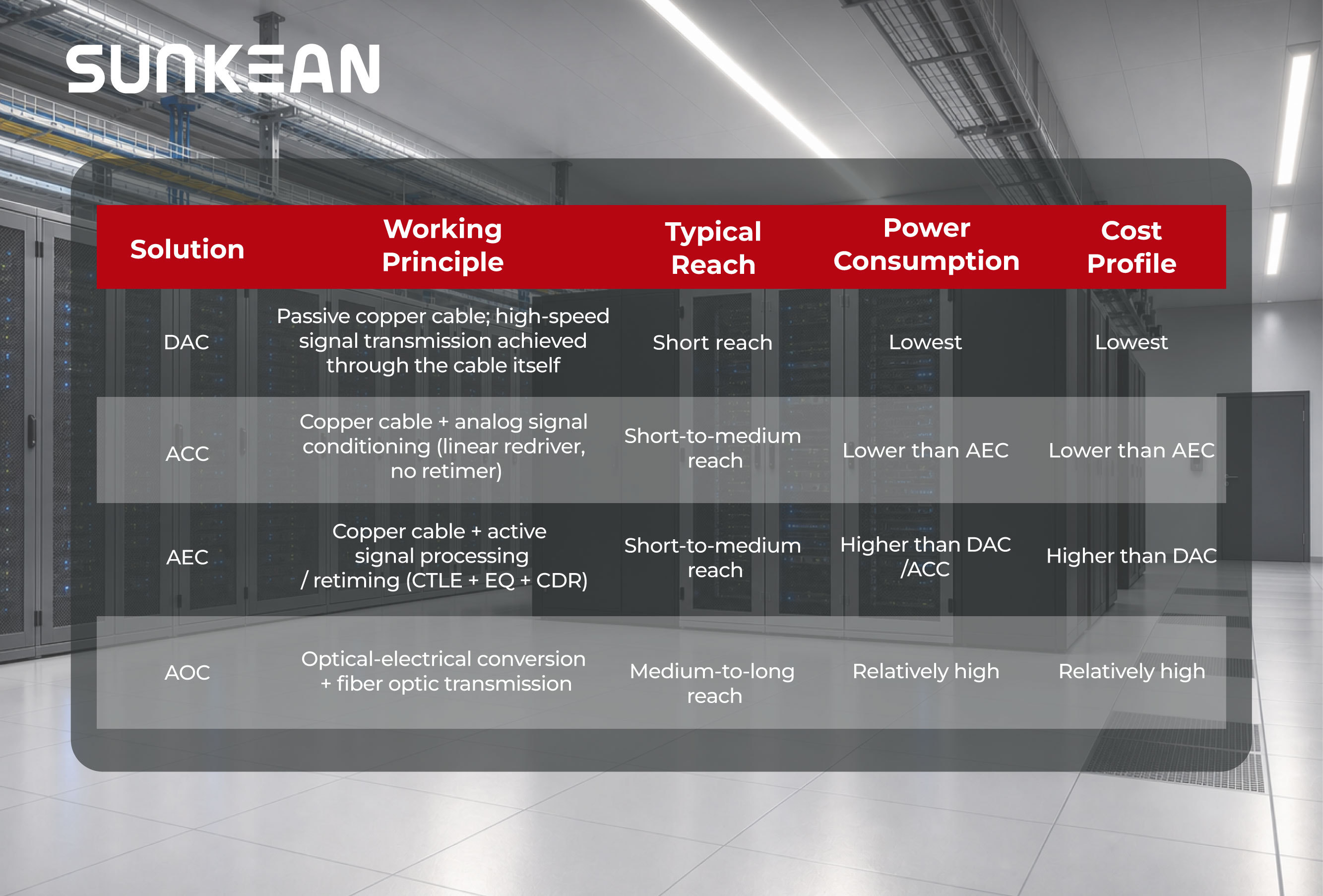
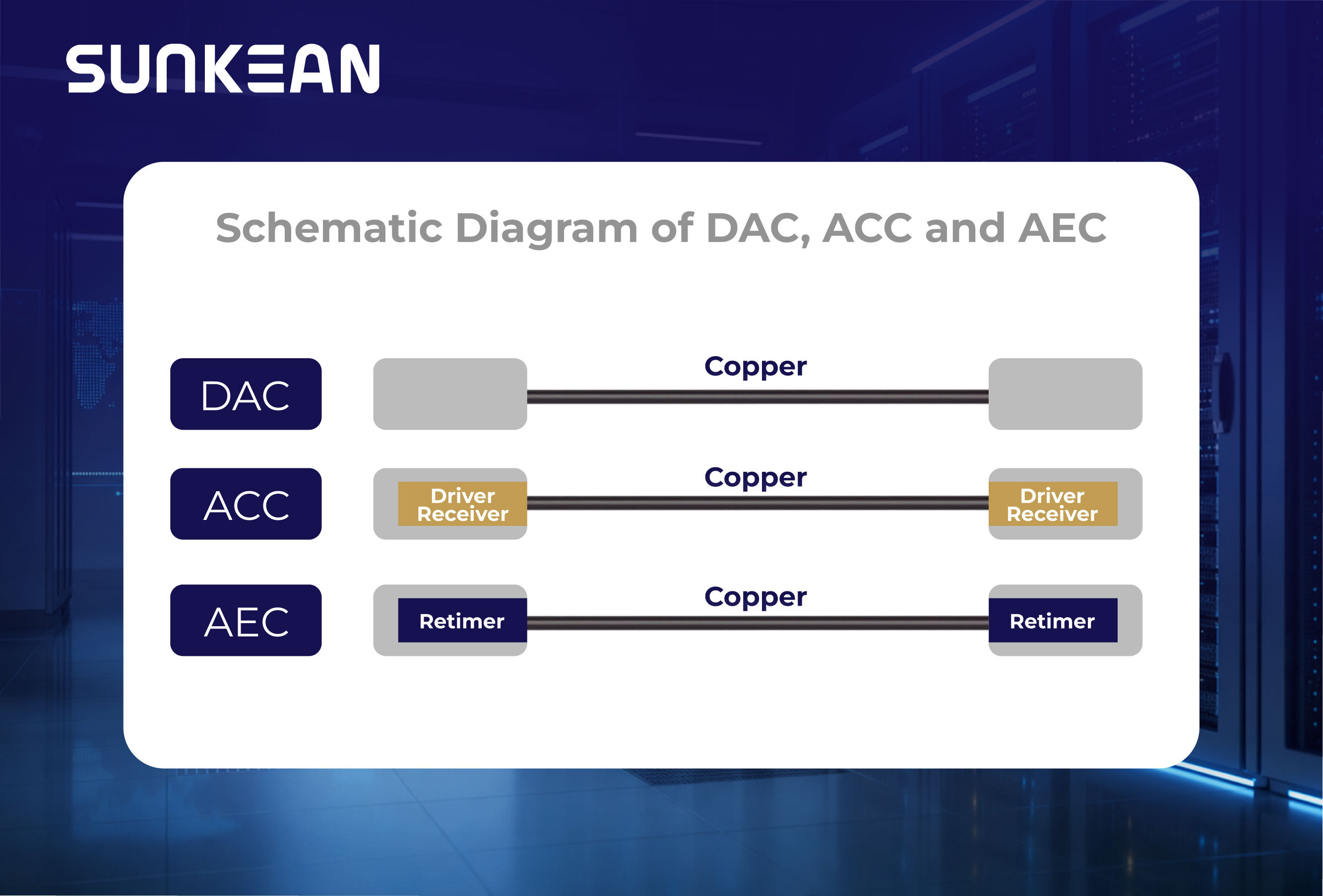
Starting from the Wire Itself: Where Are the Performance Limits of High-Speed Copper Cables
From Servers to Switches: Where Exactly Are High-Speed Copper Cables Used